

This June, London will once again become a meeting point for the people building, funding and questioning the future.
The wider London Tech Week 2026 programme runs from 8–12 June, with the main Olympia London gathering taking place from 8–10 June. It brings together founders, enterprise leaders, investors, policymakers and technologists at a moment when AI, quantum, deep tech and frontier innovation are reshaping the terms of global competition.
The official themes tell us a great deal about where the conversation is heading: Applied AI and Responsible AGI, enterprise resilience, deep tech, AI infrastructure, quantum futures, unicorn growth, human impact and the UK and Europe’s place in global technology.
In other words: big ideas, big systems, big promises.

Beneath all of that sits a quieter, more human question: can people understand what is being built, and can they believe in it?
Technology’s future will belong not only to those who invent it, but to those who can explain it with clarity, honesty and imagination.
Storytelling earns its place here. It should not be treated as a decorative layer or a last-minute content task, but as the framework that helps people understand what a company is building, why it matters and why it deserves trust. In modern technology, clear communication is becoming infrastructure.
Innovation is not enough
Britain’s technology sector is not lacking ambition. Its AI ecosystem, in particular, is moving with extraordinary pace.
Tech Nation reported that the UK is home to more than 2,300 VC-backed AI companies, with the sector reaching a combined market valuation of $230bn in Q1 2025. UK AI startups also raised $1.03bn in venture investment in that quarter alone, the strongest first-quarter fundraising performance of the previous three years.
Those figures are impressive not simply because they show scale, but because they reveal density. This is not a thin field dominated by a handful of companies. It is a busy, fast-moving ecosystem in which thousands of ventures are competing for attention, capital, talent and trust.
The pace is thrilling, but the market is crowded.

When so many companies describe themselves as “AI-powered”, “mission-led”, “disruptive” or “transforming the future of work”, the language begins to blur. In a crowded market, visibility is no longer just a question of being present. It is a question of being understood.
The companies that stand out are not always the loudest. They are the ones that understand the problem precisely, know who they are serving, can explain why this moment matters and have a clear view of the future they are trying to build.
Technology does not exist in isolation. It enters homes, classrooms, hospitals, offices, banks, supply chains and public systems, changing how people behave, make decisions and place their trust.
That is why the way tech is explained cannot be treated as an afterthought. It must carry a sense of responsibility.
A founder’s story, at its best, is not a polished origin myth, but a public account of purpose.
Trust is a growth strategy
For years, many startups were encouraged to treat the product as the whole argument:
Build quickly, ship quickly and explain later.
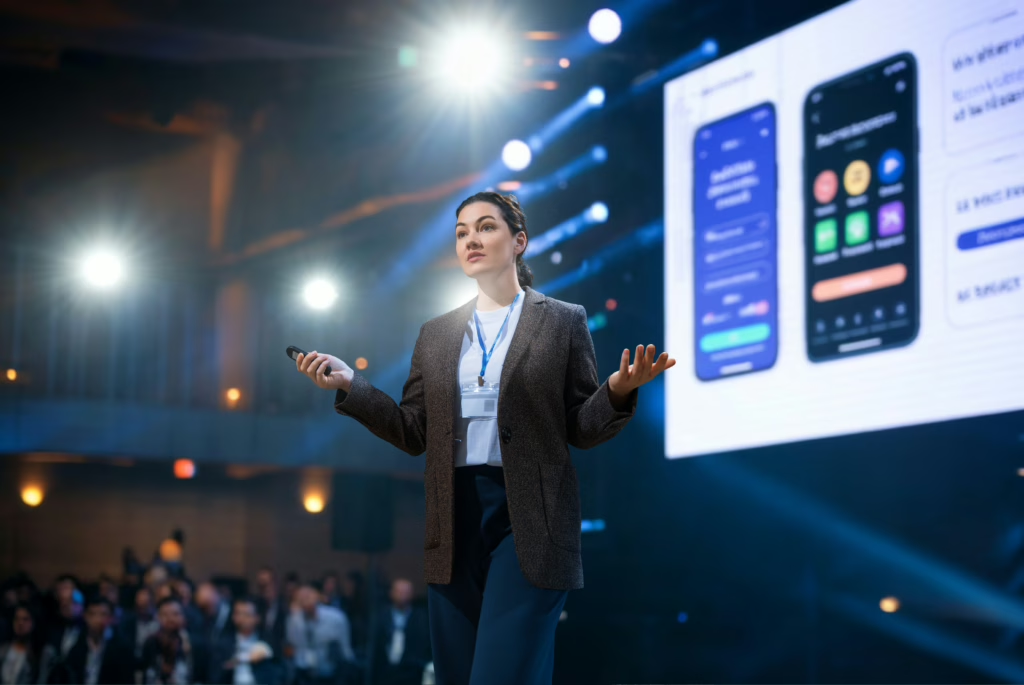
However, “explain later” has become a fragile strategy. The more complex the technology, the greater the burden of clarity. AI, robotics, life sciences, cybersecurity and climate innovation all depend on people placing trust in systems they may never fully understand.
That trust is built through consistency, evidence and language that respects the intelligence of the audience.
The best technology communication does not patronise people, nor does it hide behind technical fog. It creates a bridge between what a company knows and what the market needs to understand.
That bridge is where growth begins. Investors use it to judge potential. Customers use it to understand value. Partners use it to assess credibility. Journalists use it to find the wider story. Teams use it to remember why the work matters, especially on the days when progress feels less like a moonshot and more like wrestling a spreadsheet in a cupboard.
And there will always be those days. Even in tech. Especially in tech.
Founder storytelling is not fluff
There is a tendency to treat storytelling as the softer cousin of strategy: useful for LinkedIn posts, nice for the About page and pleasant enough when someone needs a quote for a press release.
But founder storytelling, done properly, is not fluff. It is strategic evidence.

It answers the questions people are already asking: what problem is being solved, why this founder and team are credible, why the market matters now and why anyone should care.
The strongest founder stories are not polished fairy tales. They do not need a cinematic childhood flashback, a garage, or a dramatic window stare in black and white.
They need truth, context and direction.
A strong founder story explains the relationship between lived experience, market insight and product vision. It helps people understand not only what a company does, but why it exists.
That is especially important for early-stage companies. Before there are years of case studies, revenue graphs or global customer logos, there is often a founder, a product, a problem and a belief.
The story has to help people see the shape of what is coming.
The best tech stories are human
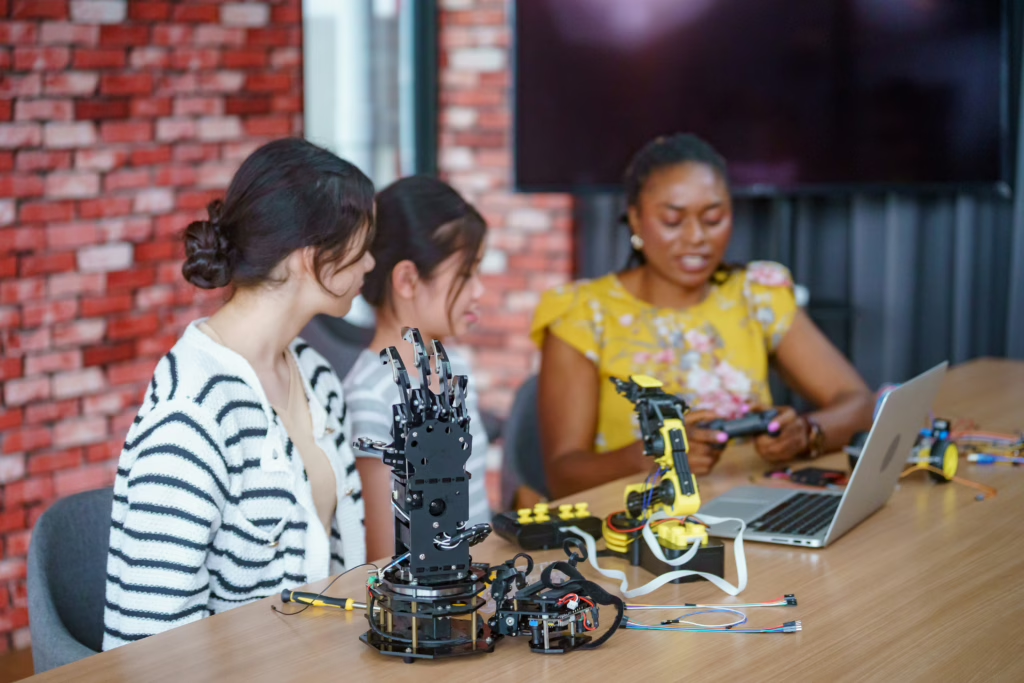
London Tech Week’s 2026 agenda stretches across areas including Applied AI, Planet & Life Sciences, People & Culture and Tech for Humanity. That range matters because it suggests a necessary shift in the conversation: technology is no longer being judged only by what it can do, but by what it is for.
That shift feels not only welcome, but overdue.
The strongest technology stories rarely begin with the technology itself. They begin with a human friction point: a task that is harder than it should be, a system that excludes too many people, a moment of frustration that someone decides should not be inevitable.
Be My Eyes is a beautiful example. Its founder, Hans Jørgen Wiberg, a Danish craftsman with low vision, noticed how often blind and low-vision people needed a little visual assistance with ordinary daily tasks. From that observation came a platform connecting users with volunteers and companies through live video and artificial intelligence.
What makes the story powerful is not only that the technology is impressive. It is that the technology is in service of something instantly understandable: independence, dignity and the small freedoms that shape everyday life. It reminds us that innovation does not always have to announce itself with a foghorn; sometimes it begins with the simple, radical idea that asking for help should be easier.
That is true across the wider tech landscape. A climate tech company is not merely optimising energy systems; it may be helping businesses reduce waste, cost and carbon without needing a PhD in grid infrastructure. A health tech company is not simply improving data flows; it may be helping clinicians make better decisions when time, accuracy and trust really matter. A fintech company is not just automating compliance; it may be giving teams a way to manage risk without drowning in spreadsheets and low-level panic.
The human layer is not a simplification. It is the point.
People do not connect with technology because it is technically impressive. They connect because they understand what changes when it works.
London’s human tech moment
London Tech Week has become more than a showcase. It is now an international meeting point for the people building, funding, regulating and questioning the future. London & Partners notes that the 2025 event welcomed representation from more than 128 countries, bringing together founders, global leaders, policymakers, investors and rising startups.
That global attention matters, but visibility, on its own, is not the same as understanding.
As the UK and Europe continue to define their place in the global technology landscape, London has an opportunity to champion a more thoughtful innovation culture, one that values commercial ambition, but also clarity, responsibility and public trust.
This does not mean making technology less exciting. It means making it more legible, more human, more accountable and more useful. More connected to the lives it intends to improve.
Perhaps this is where the next wave of founder communication needs to begin: with less jargon and more judgement; less theatre and more truth; less “look how clever we are” and more “here is the problem, here is why it matters and here is how we are trying to solve it”.
A little less fog machine. A little more lighthouse.
Clarity is what lasts
The next era of technology will belong to many kinds of builders: engineers, scientists, designers, researchers, operators, policymakers, investors and founders willing to attempt the difficult, the uncertain and the not-yet-proven.
Just as importantly, it will belong to those who can make that work understood.
Not necessarily the loudest voices. Not the companies with the glossiest brand decks. Not the teams who have discovered the word “ecosystem” and are now determined to take it for a long walk around every sentence.
The real advantage will sit with those who can make complexity feel clear without making it feel small, explain why their work matters without draining it of intelligence and understand that trust is not created by polish alone, but by coherence.
At Stellar & Rose, this is the part of the technology conversation we care about most: the moment an idea becomes clear enough to travel from lab to market, from founder to investor, from product idea to public imagination, from clever concept to credible company.
As London Tech Week approaches, we will be watching not only for the biggest announcements or boldest predictions, but for the stories that help us make sense of where technology is going.
The future will be shaped by those who can help the rest of us understand why it matters.
That, in its own quiet way, is a very powerful kind of infrastructure.